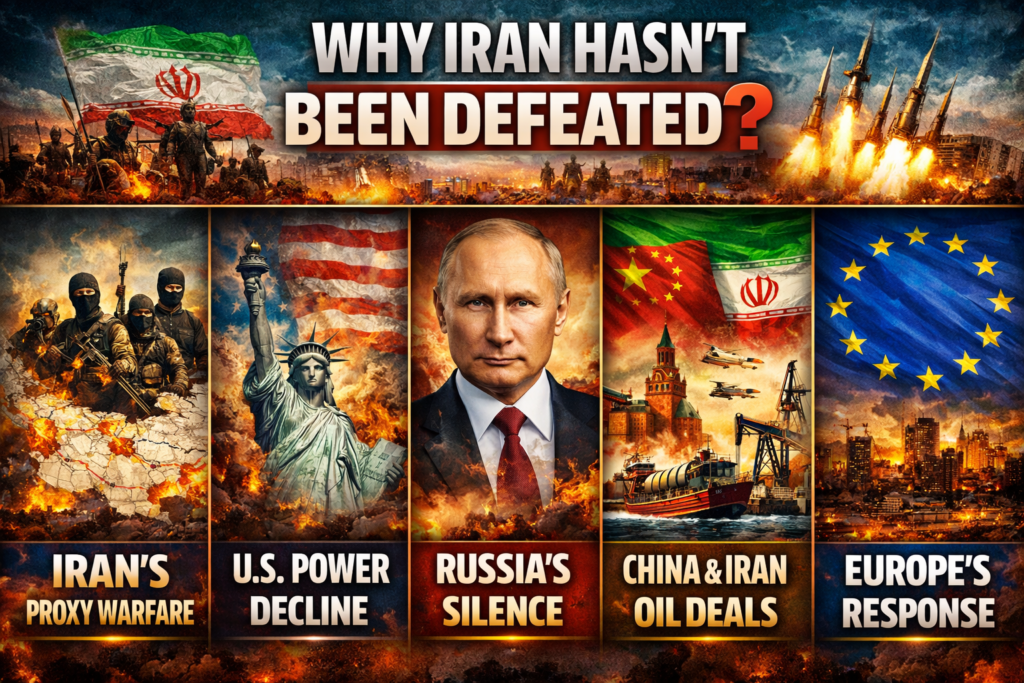

Why Iran Hasn’t Been “Defeated”: Strategy, Geopolitics, and the Silent Stakes Behind the Fighting🧭
1) How Iran’s strategy has prevented a decisive defeat — the operational anatomy
A layered, asymmetric doctrine
Why Iran Hasn’t Been Defeated: Global Powers and Strategic Balance
Why Iran hasn’t been defeated is a question many geopolitical analysts continue to debate. Despite decades of sanctions, military threats, and regional conflicts, Iran has managed to survive and maintain strategic influence in the Middle East.
Why Iran Hasn’t Been Defeated Despite Global Pressure
Iran does not primarily rely on conventional power projection; instead it uses a multi-layered asymmetric doctrine that blends:
- Proxy networks (Hezbollah, Hamas, the Houthis, and multiple Iraqi and Syrian militias) as force multipliers;
- Area denial and maritime harassment in chokepoints like the Strait of Hormuz;
- Cyberattacks, clandestine logistics, and clandestine arms transfers that are hard to attribute and harder to counter with conventional force; and
- Political and ideological influence among Shia communities and strategic partners across the Levant, Arabian Peninsula, and Iraq.
This approach lets Tehran strike, coerce, and impose costs while avoiding a battlefield where its regime could be toppled by a single conventional strike. Academic and policy studies show Iran’s surrogate network provides strategic depth and plausible deniability — a classic asymmetric playbook that complicates direct retaliation. (iais.uz)
Why proxies matter tactically and politically
Why Iran Hasn’t Been Defeated: The Power of Proxy Warfare
One major reason why Iran hasn’t been defeated is its use of proxy warfare. Instead of relying only on conventional armies, Iran supports allied groups across the region.
- Plausible deniability: Using proxies allows Iran to impose costs on adversaries without triggering a direct declaration of war, slowing or preventing coalitions from mounting all-out retaliation.
- Distributed pressure: Proxy groups allow persistent low-to-medium intensity pressure across multiple theaters so adversaries must fight on many fronts (maritime, Lebanon/Syria, Gaza/Yemen).
- Domestic insulation: Waging war through intermediaries protects Iranian territory and regime infrastructure from immediate destruction while signaling resolve to domestic audiences and regional clients.
Put together, this makes “defeating Iran” not a single military task but a series of political, economic, intelligence, and time-consuming campaigns — many of which have high costs and ambiguous endstates.
2) Who threatened to “start a war” and what strategies they used (escalators vs. deterrers)
When actors publicly threaten military action, they typically use two broad strategic logics:
- Escalatory coercion (Threat to force) — signaling readiness to strike decisively to deter or punish (used by states with conventional strike capacity).
- Deterrence-by-association (Backchannel/punishment via partners) — leveraging allies to punish without triggering open interstate war.
The pattern we saw
- Israel has used surgical strikes, intelligence operations, and targeted sabotage aimed at disrupting nuclear and military capabilities. Israel’s calculus is to degrade Iran’s capacity without triggering a broad regional conflagration.
- The United States (depending on the administration) mixes deterrent posturing (carrier groups, strikes on specific Iranian assets), sanctions, and diplomatic pressure. The U.S. tends to prefer high-precision punitive measures rather than prolonged land campaigns, because of domestic constraints and costs of occupation.
- Gulf states have often preferred deterrence-by-proxy: building air defenses, buying deterrent capabilities, and quietly tolerating certain military steps by partners.
Strategically, those who threaten war often rely on tempered coercion: visible pressure calibrated to enforce red lines while avoiding spirals that could lead to regime-ending warfare or direct great-power confrontation.
3) Where did U.S. regional power go? Has America lost influence — and why?
The claim that U.S. influence in the Middle East has eroded is complicated but supportable in multiple dimensions:
- Credibility gap and policy inconsistency. Shifting U.S. policies (from Iraq surge to withdrawal, varied Iran policies, and executive changes) have produced uncertainty among regional partners about long-term commitments. This damages deterrence credibility.
- Resource re-prioritization. The U.S. has re-oriented attention and political capital to strategic competition with China and to Europe (Ukraine), limiting willingness to commit major ground forces in the Middle East.
- Local legitimacy and public opinion. Polling since 2023 shows declining favorable views of the U.S. among many Arab publics after high-profile conflicts and perceived double standards, which reduces American soft power leverage. (rawabetcenter.com)
But nuance: capability vs. will
The United States retains overwhelming conventional military capability in the region (airpower, logistics, ISR), but political will — the threshold to deploy and sustain large formations or accept high civilian or allied casualties — is lower. So the U.S. can punish, degrade, and deter to an extent, but not reliably guarantee regime change or to construct long-term security every time a crisis arises, especially when political costs at home are high.
One major reason why Iran hasn’t been defeated is its use of proxy warfare. Instead of relying only on conventional armies, Iran supports allied groups across the region.
Did the world “boast” that America was the unquestioned global hegemon — and what happened to that “global power” notion?
The unipolar moment of the 1990s — where the U.S. was broadly perceived as the sole global superpower — has been eroded by several structural trends:
- Strategic multipolarity: Russia’s assertiveness (especially after 2014) and China’s rapid economic-technological rise have created credible alternatives and leverage points for regional actors.
- Erosion of norms and institutions: Authoritarian great powers have shown a willingness to flout norms, weakening institutions that historically amplified U.S. influence.
- Economic interdependence and de-risking: Europe and Asian powers balance political alignment with economic ties to Russia/China/Iran; sanctions are costly and imperfect.
Practically: the U.S. remains extraordinarily capable but faces harder geopolitical arithmetic — other powers can offset or complicate U.S. options, which reduces the scope of unilateral solutions.
Understanding why Iran hasn’t been defeated also requires examining global power politics involving the United States, Russia, China, and European countries.
4) Russia’s silence/ restraint — is Moscow benefitting or losing?
Why Russia Remains Silent in the Iran Conflict
Why Russia is relatively quiet (and why that makes strategic sense)
Russia has publicly supported Tehran diplomatically but resisted direct military entanglement. Reasons include:
- Leverage management: Russia wants to keep diplomatic room with the West on issues (e.g., Ukraine negotiations) while extracting economic and strategic gains from Iran. Open alignment risks escalation and secondary sanctions.
- No automatic defense obligation: Recent strategic partnerships (e.g., treaties signed in 2025) have been transactional and don’t obligate Moscow to fight for Tehran. (Middle East Council on Global Affairs)
- Risk aversion: Russia cannot easily open a new front or absorb another round of sanctions/retaliation when it already faces major challenges (Ukraine and global financial strains).
Gains and losses for Russia
- Possible gains: Higher energy prices can improve Russia’s revenues; political distraction from Europe/Ukraine; bargaining chips in diplomacy.
- Clear limits / losses: Russia’s credibility with regional partners is tested when it fails to defend allies under pressure; long-term influence risks if Tehran perceives Moscow as an unreliable security guarantor. (Le Monde.fr)
So Russia’s silence reflects realpolitik tradeoffs: short-term economic and diplomatic advantage at the cost of limited security credibility.
Does the conflict benefit Iran (or others) via “destruction profits” — who gains and who loses?
Why Iran Hasn’t Been Defeated in the Middle East
Who can gain
- Energy exporters (some): Disruptions raise oil and gas prices; major producers with market access can benefit temporarily.
- Domestic political consolidation: Crises often rally hardline domestic political factions around regimes (for Iran, this can be an internal political gain).
- Strategic distraction for rivals: A crisis focusing global attention on Iran can reduce scrutiny on other theatres (e.g., Russia uses distraction strategically).
Who loses
- Regional economies and vulnerable states: Higher fuel prices, shipping insurance costs, and trade disruptions damage import-dependent economies.
- Great powers’ economic interests: Europe and Asia can lose supply security; sanctions and volatility reduce industrial stability.
- Proxy groups and long-term influence: Persistent conflict can exhaust proxies, erode local popular support, and damage Iran’s long-term soft-power.
Bottom line: some actors extract short-term gains from disorder, but structural stability and long-term influence are generally harmed by protracted conflict.
Why didn’t Russia or other powers “stand up” like the U.S. did for Israel — why not symmetric backing?
Why Iran Hasn’t Been Defeated in the Middle East Power Struggle
China and Russia’s Strategic Silence
Two overlapping reasons:
- Asymmetric interests and constraints. Supporting Israel with military tools is different from supporting Iran. Russia and China weigh secondary sanctions, oil market impacts, and their own strategic vulnerabilities.
- Risk calculus. Direct military backing risks open confrontation with the other side; restraint preserves diplomatic flexibility and avoids uncontrolled escalation.
Additionally, great powers often prefer indirect tools (diplomacy, economic lifelines, arms transfers through deniable channels) to preserve options and manage escalation.
Understanding why Iran hasn’t been defeated also requires examining global power politics involving the United States, Russia, China, and European countries.
5) China’s role: cheap oil, sanctions evasion, and “pragmatic hedging”
China has developed increasingly deep economic links with Iran in ways that matter strategically:
- Major buyer of discounted Iranian oil. China has been the principal destination for Iranian crude exports when Western markets were closed. This trade often flows through shadow shipping, ship-to-ship transfers, and opaque financing mechanisms. (Atlantic Council)
- Industrial and technological ties. China supplies equipment, investment, and sometimes dual-use technologies (through complex supply networks) that help Iran mitigate sanctions impacts.
- Strategic caution: Despite these ties, Beijing often avoids overt military backing for Tehran because it does not want to risk destabilizing primary energy supplies, provoke secondary sanctions that would harm global trade exposure, or spark a wider war that threatens supply chains.
Put simply: China’s calculus emphasizes resource access and political hedging — maximum economic extraction with minimal military entanglement.
Understanding why Iran hasn’t been defeated also requires examining global power politics involving the United States, Russia, China, and European countries.
Why China Does Not Overtly Support Iran Militarily or Politically 🇨🇳
Why China Does Not Openly Support Iran
China has strong economic ties with Iran, but it avoids openly supporting Iran in wars for several strategic reasons:
– Protecting Its Economy 💹
China depends heavily on trade with the U.S. and Europe, which are major markets for Chinese goods. Open military support for Iran could lead to severe sanctions that harm China’s economy.
– Avoiding Conflict With the U.S. ⚔️
If China openly backed Iran, it could create direct confrontation with the United States, something Beijing prefers to avoid while focusing on economic growth and regional influence.
– Maintaining Relations With Other Middle Eastern Countries 🌍
China also has strong partnerships with Saudi Arabia, UAE, and other Gulf states. Supporting Iran openly could damage these important relationships.
– Securing Stable Oil Supplies 🛢️
China buys discounted oil from Iran but prefers regional stability. A large war could disrupt oil routes like the Strait of Hormuz, which would threaten China’s energy supply.
– Strategic Approach: Economic Influence 🤝
Instead of military alliances, China prefers economic cooperation, trade, and investment to expand influence while avoiding military risks.
6) Europe’s posture — what did the EU and Europeans get from the conflict?
European Union and European states have three main motives shaping their responses:
- Stability and energy security. Europe fears disruption to supplies and price shocks; its immediate priority is de-escalation and protecting shipments.
- Norms and international law. European diplomacy often emphasizes international legal mechanisms, restraint, and humanitarian concerns — but practical leverage is constrained by energy interdependence and divided member state views.
- Strategic hedging. Europe wants to preserve ties with the U.S. and Middle Eastern partners while protecting economic interests with Russia and China; therefore, European responses are often calibrated, not maximalist.
The result: active diplomacy, calls for de-escalation, limited sanctions diplomacy, and a focus on humanitarian and legal mechanisms rather than direct military backing beyond coalition air defenses or logistical cooperation.
Understanding why Iran hasn’t been defeated also requires examining global power politics involving the United States, Russia, China, and European countries.
Hidden data and opaque dynamics (the “secret files” question)
There are several opaque channels that shape the conflict without appearing on front pages:
- Shadow fleets and ship-to-ship transfers that mask origin/destination of oil shipments.
- Non-transparent financing through third-country banks, shell companies, and quasi-state actors to fund arms and supplies.
- Covert cyber and intelligence operations that target critical nodes, complicating attribution and public debate.
- Back-channel diplomacy — secret communications that de-escalate or manage crises but remain unseen.
Understanding the conflict requires tracking both public military moves and this hidden infrastructure; enforcement gaps and legal friction points often determine whether sanctions bite or leak. read more details
Understanding why Iran hasn’t been defeated also requires examining global power politics involving the United States, Russia, China, and European countries.
How the balance could shift — scenarios and policy implications
Short term (order of months)
- Escalation stabilizes through limited de-escalatory deals (diplomatic agreements, tacit no-escalation pacts).
- Energy shocks cause price volatility and spur temporary re-routing of supplies.
Medium term (1–2 years)
- Proxy fatigue may weaken Iran’s external leverage if partner groups suffer attrition or political backlash.
- Great-power diplomacy (Russia/China/EU/U.S.) will determine whether Iran is further isolated economically or partially shielded.
Long term (several years)
- Structural outcomes will turn on whether Iran can industrially re-insulate (via China/Russia), whether the U.S. rebuilds regional alliances, and whether domestic politics inside Iran tilt toward moderation or hardline consolidation.
Conclusion — accurate takeaways (short & sharp)
- Iran resists “defeat” because it doesn’t play by conventional rules: a proxy-based, distributed, and deniable strategy raises the cost of decisive military action and complicates attribution. (iais.uz)
- U.S. power is large but its political will to sustain massive ground operations has declined; influence has eroded in relative terms because of strategic re-prioritization and credibility gaps. (IISS)
- Russia and China act opportunistically, gaining some economic and diplomatic advantages from instability while avoiding direct entanglement that could trigger costly escalation. (The Wall Street Journal)
- Europe plays a cautious diplomatic role, constrained by energy, divided politics, and institutional limits.
- The conflict produces short-term beneficiaries (energy exporters, opportunistic actors) but long-term costs for regional stability and global trade.
Understanding why Iran hasn’t been defeated also requires examining global power politics involving the United States, Russia, China, and European countries.