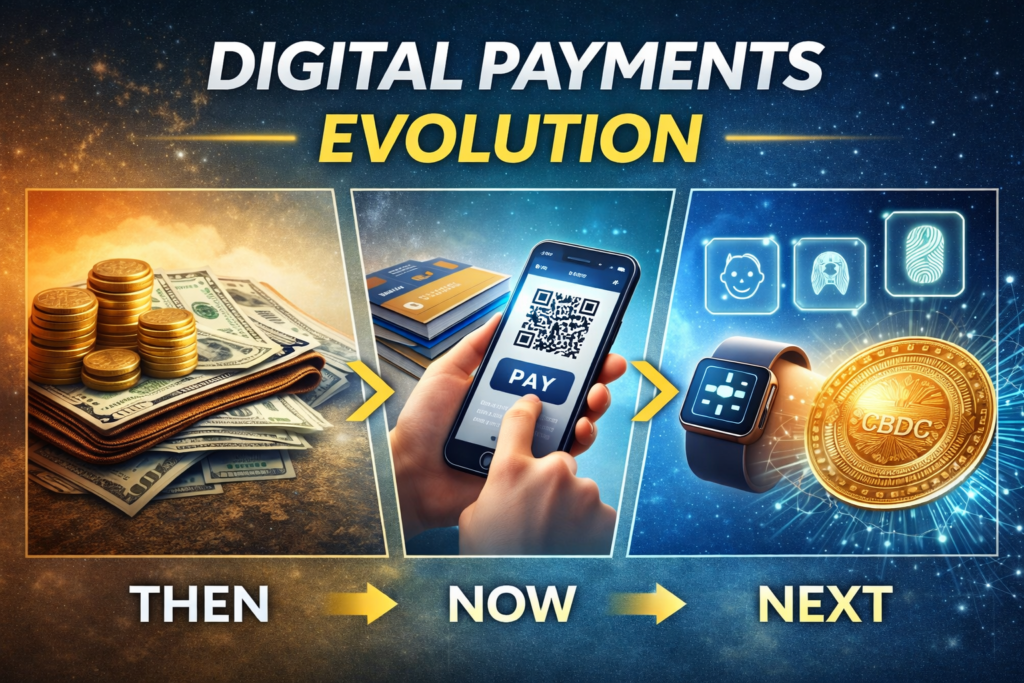

Digital Payments Then, Now, and Next: The Evolution of Money From Cash and Cards to the Future of Global Finance
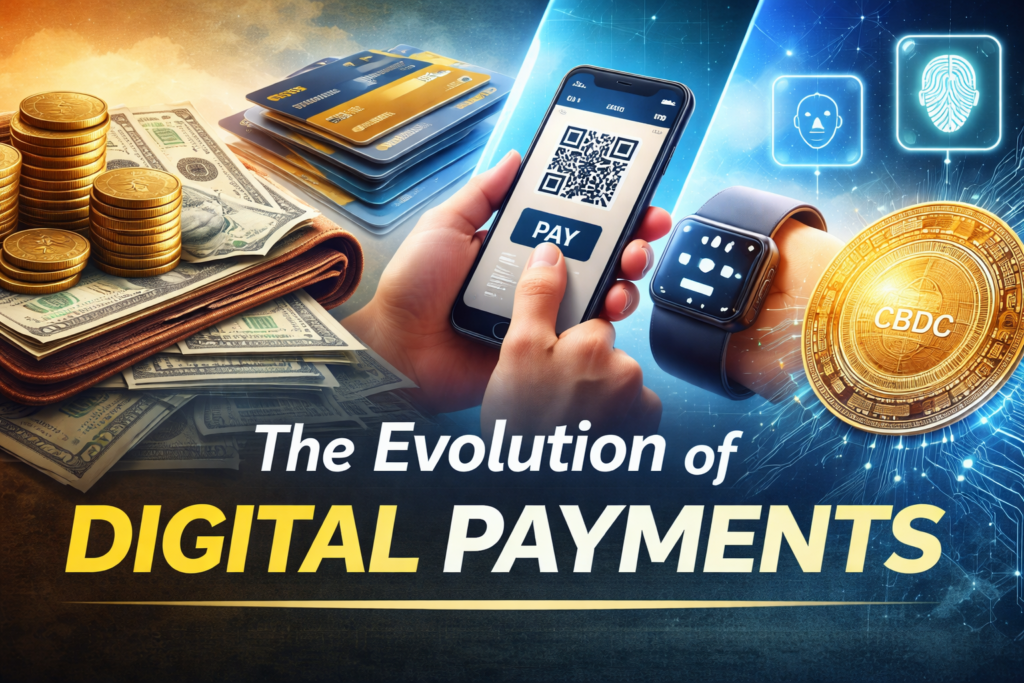
Digital Payments Evolution: 7 Powerful Trends Shaping the Future of Money
Digital payments evolution explains how money has transformed from physical cash and cards into mobile payments, digital wallets, and future digital currencies.
Money has never been static. From barter systems and metal coins to mobile wallets and digital currencies, the way humans exchange value has continuously evolved alongside technology, trade, and society. Today, the world stands at a pivotal moment: cash is declining, digital payments dominate daily life, and entirely new forms of money are emerging.
This article explores the full evolution of payments—from the earliest systems, through modern digital payment technologies, to the future of global money in an increasingly cashless world.
The digital payments evolution reflects how money has transformed from cash and cards into mobile wallets, digital currencies, and automated financial systems.
The Early Foundations of Money and Payments
Barter, Coins, and Physical Cash
Long before digital systems, economic exchange relied on barter—goods traded directly for other goods. While simple, barter was inefficient and limited by the “double coincidence of wants.” The invention of money solved this problem.
Metal coins, followed by paper banknotes, became standardized stores of value issued by states and empires. For centuries, physical cash dominated global commerce, enabling trade, taxation, and economic expansion.
Cash offered:
- Universality
- Anonymity
- Simplicity
However, it also came with limitations—difficulty in tracking, risks of theft, and inefficiencies in large-scale or cross-border transactions.
The digital payments evolution continues to reshape how individuals and businesses exchange value worldwide.
The Transition Era: Banks, Checks, and Cards
Digital Payments Evolution in the Mobile-First Era
Banking Systems and Non-Cash Instruments
As economies grew more complex, banks introduced checks, wire transfers, and account-based money. These innovations reduced the need to physically move cash and laid the groundwork for modern payment systems.
The Rise of Credit and Debit Cards
The mid-to-late 20th century marked a major shift with the introduction of credit and debit cards. Cards digitized payments for the first time at scale, enabling:
- Consumer credit
- Global commerce
- Secure, account-linked transactions
For decades, cards represented the bridge between physical cash and fully digital payments. Yet, they still depended heavily on legacy banking infrastructure.
The Digital Payments Revolution (Now)
The Digital Payments Evolution: From Cash to Cards
Mobile Payments and Digital Wallets
Digital Payments Evolution and the Rise of CBDCs
In the 2010s and 2020s, smartphones transformed payments. Mobile wallets, QR codes, and app-based transfers allowed users to send and receive money instantly—often without banks as intermediaries.
By the mid-2020s:
- Mobile-first payments became dominant in many regions
- Small merchants adopted QR payments over card terminals
- Peer-to-peer transfers replaced cash for everyday use
Digital payments are now defined by speed, convenience, and integration into daily digital life.
Analysts believe the digital payments evolution is accelerating the shift toward a cashless global economy.
Embedded and Invisible Payments
Payments today are often invisible. Ride-hailing apps, subscriptions, e-commerce platforms, and streaming services embed payments seamlessly into user experiences. Transactions happen in the background, with minimal user interaction.
This shift has redefined expectations:
- Frictionless checkout
- Always-on payments
- Global access
The digital payments evolution continues to reshape how individuals and businesses exchange value worldwide.
The Role of Data, AI, and Automation
Modern digital payments are not just about transferring money—they are data-driven systems.
Artificial intelligence now:
- Detects fraud in real time
- Scores transaction risk
- Automates compliance and monitoring
While this improves security and efficiency, it also raises concerns about surveillance, transparency, and algorithmic decision-making.
The Next Phase: The Future of Global Money
Central Bank Digital Currencies (CBDCs)
How the Evolution of Digital Payments Changed Consumer Behavior
One of the most significant developments shaping the future of money is the rise of Central Bank Digital Currencies (CBDCs). Unlike cryptocurrencies, CBDCs are state-issued digital versions of national currencies.
Governments see CBDCs as tools to:
- Modernize payment infrastructure
- Improve financial inclusion
- Reduce cash dependency
- Strengthen monetary policy transmission
In the future, CBDCs may coexist with cash, bank deposits, and private digital wallets—reshaping how citizens interact with money.
Cryptocurrencies and Tokenized Assets
While volatile, cryptocurrencies introduced powerful ideas:
- Borderless payments
- Decentralization
- Programmable money
Beyond consumer payments, blockchain technology increasingly supports:
- Cross-border settlements
- Smart contracts
- Tokenized real-world assets
In the future, much of this infrastructure may operate behind the scenes rather than replacing traditional money outright.
International institutions such as the International Monetary Fund (IMF) highlight the growing role of digital payments in financial inclusion.
👉 Link: https://www.imf.org
Biometric and Identity-Based Payments
The next generation of payments is closely tied to identity. Biometric authentication—fingerprints, facial recognition, iris scans—is becoming common in payment authorization.
This evolution raises fundamental questions:
- Who controls identity data?
- How is privacy protected?
- What happens when identity and money fully merge?
From Cashless to Trust-Based Economies
As the world moves toward cashless systems, trust becomes the most valuable currency. Digital payments depend on:
- Cybersecurity
- Reliable infrastructure
- Fair regulation
- Public confidence
A system that is fast but untrusted will fail. The future of money depends not only on innovation, but on governance and accountability.
Challenges in the Evolution of Digital Payments
Challenges Shaping the Future of Digital Payments
Despite progress, significant challenges remain:
- Cyberattacks and system failures
- Digital exclusion of vulnerable populations
- Regulatory fragmentation across borders
- Loss of privacy and anonymity
Balancing innovation with inclusion and rights will define the success of future payment systems.
Explore related insights in our FinTech section.
What Comes Next?
The evolution of digital payments is not linear. Cash will not disappear overnight, cards will not vanish instantly, and digital currencies will not replace everything at once. Instead, the future will be hybrid—a layered ecosystem where old and new systems coexist.
Money is becoming:
- More digital
- More programmable
- More interconnected
- More political
In the coming years, the digital payments evolution will define the future of financial systems.
Conclusion
From barter and cash to cards, mobile wallets, and digital currencies, the evolution of payments reflects broader shifts in technology, power, and society. Today’s digital payments are not the endpoint, but a transition toward a new financial era.
As the world moves forward, the key question is not whether money will become digital—it already has—but how digital money will be governed, trusted, and shared in a rapidly changing global economy.
Analysts believe the digital payments evolution is accelerating the shift toward a cashless global economy.