

What Happened on January 3, 2026
US Military Strikes and Maduro “Capture”
From the Start of the Venezuela Conflict
Venezuela conflict Russia has become one of the most discussed geopolitical issues in 2026, as tensions between the United States and Venezuela escalated rapidly.
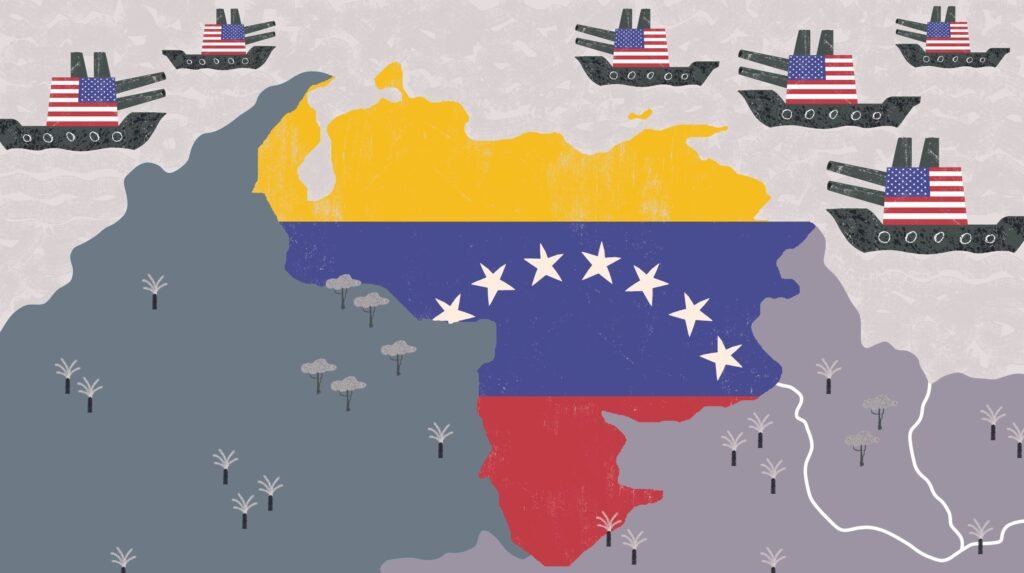
On January 3, 2026, the United States carried out military strikes against Venezuela, targeting military and other strategic sites in and around Caracas and the states of Miranda, Aragua, and La Guaira. Explosions and aircraft activity were reported early in the morning. (TIME)
How the U.S.–Venezuela Crisis Began in 2026
U.S. President Donald Trump announced that Venezuelan President Nicolás Maduro and his wife Cilia Flores were captured by U.S. forces and flown to New York to face criminal charges, including narcoterrorism and related offenses. The administration declared that the United States would temporarily govern Venezuela to oversee a “safe and proper transition.” (CBS News)
This action represents one of the most direct U.S. interventions in Latin America in decades. (Reuters)
Claims, Legality, and Reactions
U.S. Position
- The Trump administration framed the action as part of a broader strategy against drug trafficking and organized crime linked to the Maduro government. (CBS News)
- Trump stated that Maduro would face U.S. criminal charges and insisted that Venezuela’s oil infrastructure and resources would be used to benefit the Venezuelan people and the economy under transitional oversight. (Axios)
Venezuela’s Response
- The Venezuelan government condemned the strikes as “military aggression” and a violation of sovereignty, declaring a national emergency. (Reuters)
- Vice-President Delcy Rodríguez demanded proof of life for Maduro and his wife amid conflicting reports on their whereabouts. (ITVX)
International Reaction
- Several countries, including Russia, Iran, Cuba, and Colombia, condemned the U.S. action as violation of international law and imperialism. (CBS News)
- U.S. lawmakers were sharply divided, with some Republicans defending the action and many Democrats criticizing it for lacking congressional authorization. (Al Jazeera)
Was Maduro Actually “Kidnapped”?
The term “kidnapped” has appeared in international commentary and in Venezuelan government statements reflecting their position that the U.S. action was illegal. Independent news reports confirm that Trump publicly claimed Maduro was captured and taken to the U.S., though Venezuelan authorities demand proof of life and the situation on the ground remains chaotic. (ITVX)
In essence:
- Trump claims Maduro is in U.S. custody and will face charges.
- Venezuelan authorities say his whereabouts are uncertain and denounce the action as illegal.
This difference in narratives reflects the ongoing information conflict.
Why This Happened — Underlying Causes
What This Conflict Reveals About Global Power
Escalation of Tensions Before 2026
This operation did not occur in isolation; tensions had been building for months in 2025:
- The U.S. deployed significant military forces to the Caribbean Sea, including aircraft and warships. (Wikipedia)
- The Trump administration conducted airstrikes and covert operations against what it described as drug trafficking networks linked to Venezuela, resulting in the deaths of more than 100 people. (Wikipedia)
- In late 2025, Trump ordered a total blockade of sanctioned Venezuelan oil tankers and seized at least one vessel. (Xinhua)
- Trump publicly said military force could be used against Venezuela if necessary, explicitly leaving open the possibility of land operations against targets. (Daily Sabah)
These pressures contributed to an environment in which military action was considered by the U.S. administration. (Anadolu Ajansı)
Core Motivations from U.S. Perspective
According to official statements and policy decisions by the Trump administration, key motivations include:
- Combating drug trafficking and narco-terrorism affecting the United States. (Wikipedia)
- Targeting Maduro’s government as an illegitimate and harmful regime. (CBS News)
- Securing access to Venezuela’s strategic resources, including oil, which Venezuela holds among the largest reserves in the world. (internationalviewpoint.org)
Critics and international observers, however, argue that these justifications mask broader geopolitical and economic interests.
Has Venezuela Engaged in War Before?
Historical Context
- Venezuela has had a long history of tension with the U.S. — including past sanctions, political disputes, and economic pressure — but large-scale direct U.S. military intervention had not occurred in decades. The most recent comparable action was the U.S. invasion of Panama in 1989. (Reuters)
Current Conflict Classification
The January 3, 2026 events represent a major escalation — possibly constituting international armed conflict or military occupation, though legal debates continue.
How Venezuela Could Defend or Respond
This analysis of the Venezuela conflict Russia relationship highlights how global power dynamics shaped the 2026 crisis.
Military and Civil Defense
Venezuela has limited conventional military capability compared to the United States. Its main defensive options include:
- Mobilizing armed forces and reservists.
- Seeking defensive support or diplomatic cover from allied states (e.g., Russia, Iran, Cuba).
- Resorting to asymmetric warfare tactics.
Diplomatic and Legal Strategies
- Venezuela has requested United Nations Security Council attention and international condemnation. (ITVX)
- It can pursue legal action in international courts alleging violations of sovereignty and international law.
Political and Public Resistance
The government called for national mobilization and social resistance to foreign military action. (ITVX)
Current Situation (As of January 3–4, 2026)
Confirmed Developments
- The U.S. conducted military air and helicopter strikes in Venezuela. (TIME)
- Trump claims Maduro and his wife have been captured and taken to the U.S. to face charges. (CBS News)
- Venezuela’s government declares military aggression and national emergency. (Reuters)
- International reaction ranges from condemnation to support for anti-drug aims. (CBS News)
Outstanding Unknowns
- The precise location and custody status of Maduro and his wife according to independent verification.
- Whether the United States will face legal challenges through international mechanisms.
- How Venezuela’s leadership and broader society will respond in the medium term.
Why Russia and China Did Not Militarily Defend Venezuela:
Geopolitics, Power Limits, and the Ukraine Connection**
Why Russia Did Not Defend Venezuela
The Venezuela conflict Russia relationship became a major global issue in 2026 as tensions between the United States and Venezuela escalated, raising questions about Russia’s role and global geopolitics.
The reported U.S. military action against Venezuela in early 2026 triggered immediate global shock and raised one critical question:
Where were Russia and China—the two countries that had repeatedly declared themselves protectors of Venezuelan sovereignty?
For years, Russia and China publicly warned that any attack on Venezuela would be met with firm opposition. Yet when the United States reportedly launched strikes and claimed to have captured President Nicolás Maduro, neither Moscow nor Beijing intervened militarily.
This article examines why, analyzing military realities, strategic calculations, and the broader global context—particularly the war in Ukraine—to explain what actually happened and what it means for the future of global power politics.
Russia and China’s Promises vs. Reality
This analysis of the Venezuela conflict Russia relationship highlights how global power dynamics shaped the 2026 crisis.
Diplomatic Support, Not Military Guarantees
Despite strong rhetoric, neither Russia nor China ever signed a formal military defense treaty obligating them to fight on Venezuela’s behalf. Their support has historically taken three main forms:
- Diplomatic backing at the United Nations
- Economic cooperation, loans, and energy partnerships
- Political recognition of Maduro’s government as legitimate
When the U.S. operation was announced by President Donald Trump, both Moscow and Beijing condemned the action verbally, labeling it a violation of international law and national sovereignty. However, condemnation does not equal intervention.
In modern geopolitics, words are cheap; wars are not.
Why Russia Did Not Intervene Militarily
1. Ukraine Has Absorbed Russia’s Strategic Capacity
Strategic Risks of Confronting the United States
Russia is deeply entrenched in the Ukraine war, which has consumed:
- Troops and military equipment
- Financial and industrial resources
- Diplomatic capital
Opening a second direct confrontation with the United States in the Western Hemisphere would risk overstretch, something Russian military planners have worked hard to avoid.
2. Geography Works Against Russia
Venezuela is located thousands of kilometers from Russia. Any meaningful military defense would require:
- Long-distance naval deployment
- Airspace access through U.S.-aligned regions
- Sustained logistics under U.S. naval dominance
This would be militarily risky and strategically unsustainable.
3. Russia Avoids Direct War With the United States
Russia’s strategy since 2022 has focused on indirect confrontation, not head-on conflict with U.S. forces. Defending Venezuela militarily could have triggered:
- A direct U.S.–Russia clash
- NATO escalation
- Severe economic retaliation
From Moscow’s perspective, Venezuela is important—but not worth World War III.
Why China Also Stayed Out Militarily
1. China’s Doctrine: Stability Over Confrontation
China’s Position and Silent Support
China traditionally avoids military engagement far from its immediate region. Its foreign policy prioritizes:
- Trade
- Economic influence
- Long-term stability
Latin America is economically important to China, but not a battlefield China is willing to fight on.
2. No Appetite for Military Escalation With the U.S.
China’s leadership is already managing tensions over Taiwan, the South China Sea, and technology sanctions. Direct military involvement in Venezuela would:
- Endanger U.S.–China trade
- Risk sanctions
- Undermine China’s image as a “responsible global power”
3. Economic, Not Military, Leverage
China’s influence in Venezuela is financial, not martial. Beijing’s tools are loans, infrastructure projects, and diplomacy—not airstrikes or troop deployments.
Did Russia or China Approve the Attack?
Clear Answer: No
There is no evidence—diplomatic, military, or intelligence-based—that Russia or China authorized, approved, or secretly agreed to the U.S. action.
On the contrary:
- Both governments publicly rejected the legitimacy of the operation
- Both called for emergency international discussions
- Both emphasized sovereignty and non-interference
Claims that Russia “allowed” the attack confuse strategic limitation with consent.
Being unable to stop something is not the same as agreeing to it.
How Venezuela’s Military Responded
The Venezuela conflict Russia analysis shows how global power dynamics, U.S. foreign policy, and strategic limits shaped the Venezuela conflict Russia situation in 2026.
Symbolic Resistance, Limited Capacity
Venezuela’s armed forces:
- Declared a state of emergency
- Announced resistance to foreign aggression
- Mobilized internal security units
However, the military faces severe constraints:
- Aging equipment
- Limited air defense systems
- Economic strain
- Overwhelming U.S. technological superiority
This imbalance meant Venezuela’s response was defensive and symbolic, not escalatory.
The Ukraine–Venezuela Connection
The Ukraine War and Russia’s Military Limits
No Direct Link, But a Shared Global Context
There is no operational connection between the Ukraine war and events in Venezuela. However, they are linked in a broader geopolitical sense:
- Both reflect U.S. willingness to use force to shape global order
- Both show limits to Russia’s ability to counter U.S. power globally
- Both test China’s preference for restraint over confrontation
In simple terms:
Ukraine ties down Russia.
Venezuela exposes how far U.S. power can still reach.
What This Means for the World
1. Alliances Have Limits
Venezuela learned a hard lesson:
Political allies are not automatic military defenders.
2. The U.S. Still Dominates the Western Hemisphere
Despite talk of a “multipolar world,” the United States remains the decisive military power in the Americas.
3. Russia and China Are Selective Powers
Both countries choose where and when to confront the U.S.—and Venezuela was not that battlefield.
Conclusion
Russia and China did not abandon Venezuela—but they also did not fight for it. Their response reveals a fundamental truth of modern geopolitics:
Power is not just about promises, but about priorities, distance, and risk calculation.
For more context, read our in-depth analysis on global geopolitics and international power shifts.
For broader context, read our detailed analysis on global geopolitics and international conflicts.