

Why Greenland Matters: Power, Rare Earths, and the New Geopolitics of Strength
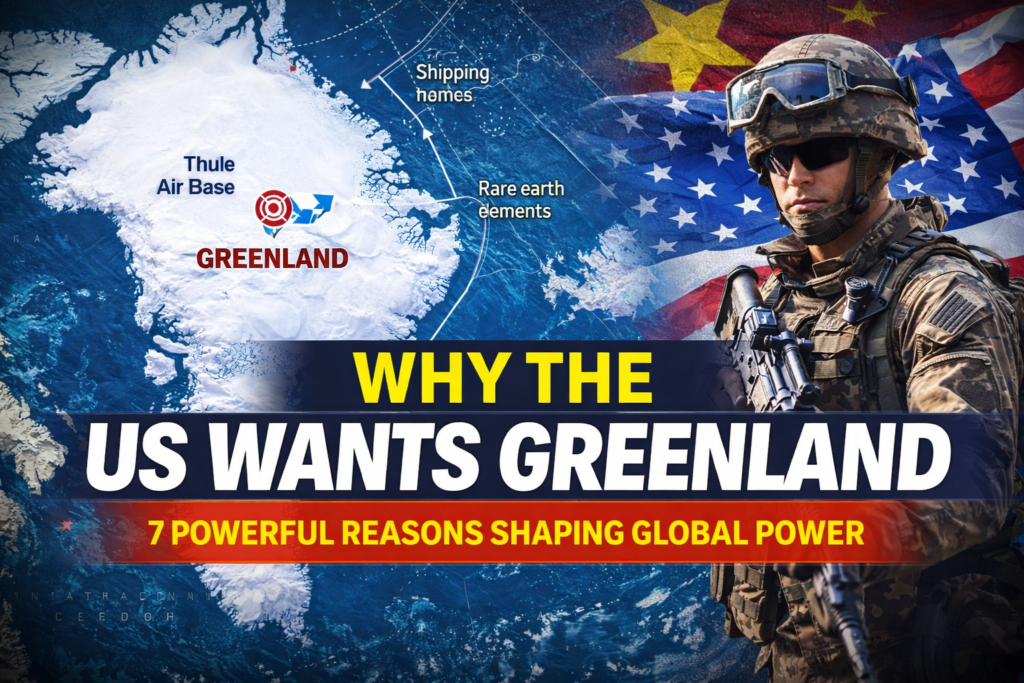
Why the US wants Greenland has become one of the most discussed geopolitical questions in the 21st century, driven by military strategy, rare earth minerals, and Arctic dominance.
Introduction: Greenland at the Center of Global Power Politics
In the 21st century, global power competition is no longer confined to traditional battlefields. Instead, it has expanded into strategic geography, critical resources, advanced technology supply chains, and the Arctic region. At the center of this transformation stands Greenland, the world’s largest island—sparsely populated, ice-covered, and long perceived as geopolitically marginal.
Yet today, Greenland is one of the most strategically valuable territories on Earth. The renewed interest of the United States, the growing presence of China, and the broader Arctic competition involving Canada and Russia reflect a deeper truth: global order is shifting toward a system where power, resources, and geography determine influence more than ideals or diplomacy alone.
This article provides a comprehensive, professional analysis of:
- Why the United States is strategically interested in Greenland
- What Rare Earth Elements (REEs) are, where they are found globally, and why nations compete over them
- Why the U.S. seeks influence over Greenland despite its proximity to Canada
- Why China is active in and around Greenland
- A concluding analysis of why the modern world increasingly rewards raw power over international norms
Understanding why the US wants Greenland requires analyzing military strategy, Arctic geography, and global power competition.
Why the US Wants Greenland in the Age of Arctic Competition
New Geopolitics Greenland
Greenland, the world’s largest island, is located between the North Atlantic and Arctic Oceans, east of the Canadian Arctic. Covering more than 2.1 million square kilometres—around 81% of which is covered by ice—Greenland has a small population of just over 56,000 people and limited infrastructure. Despite these constraints, this self-governing territory within the Kingdom of Denmark has emerged as a central focal point in the intensifying Arctic competition among major global powers, particularly the United States, Russia, and China.
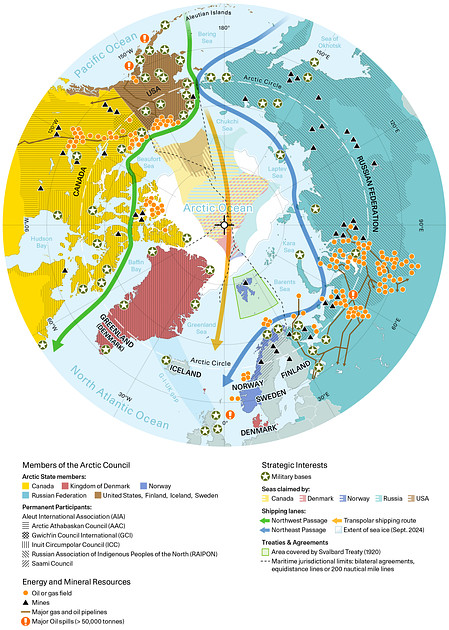
Climate change has played a decisive role in elevating Greenland’s strategic importance. Rapid ice melt is opening new Arctic shipping routes, facilitating access to vast natural resources, and expanding areas available for human, commercial, and military activity. Since Russia’s full-scale invasion of Ukraine in 2022, geopolitical tensions in the Arctic have escalated sharply, leading to NATO expansion in Northern Europe, increased military activity, and a breakdown of traditional Arctic cooperation. Once regarded as a low-tension region centred on scientific collaboration, the Arctic has now become an arena of strategic rivalry—placing Greenland at the heart of global geopolitical competition.
1. Why Does the United States Want Greenland?
Why the US Wants Greenland for Military and Arctic Control
1.1 Strategic Military Location

Greenland occupies a commanding position between North America and Europe, directly along the shortest flight and missile routes between major powers. During the Cold War, the U.S. established military infrastructure in Greenland to monitor Soviet activity. This relevance has not diminished—if anything, it has increased.
The Thule Air Base (now known as Pituffik Space Base) is a cornerstone of U.S. missile defense and early-warning systems. From this location, the U.S. can:
- Detect intercontinental ballistic missile launches
- Monitor Arctic airspace
- Track satellites and space-based threats
As the Arctic becomes increasingly navigable due to climate change, Greenland’s value as a forward military platform continues to rise.
1.2 Arctic Shipping Routes and Climate Change
Melting ice has opened new Arctic sea routes that significantly shorten travel time between Asia, Europe, and North America. Control or influence over Greenland allows the U.S. to:
- Secure emerging trade routes
- Monitor rival naval movements
- Maintain dominance in Arctic logistics and security
In a future where Arctic shipping rivals the Suez Canal in importance, Greenland becomes a geopolitical gatekeeper.
1.3 Resource Security and Economic Interests
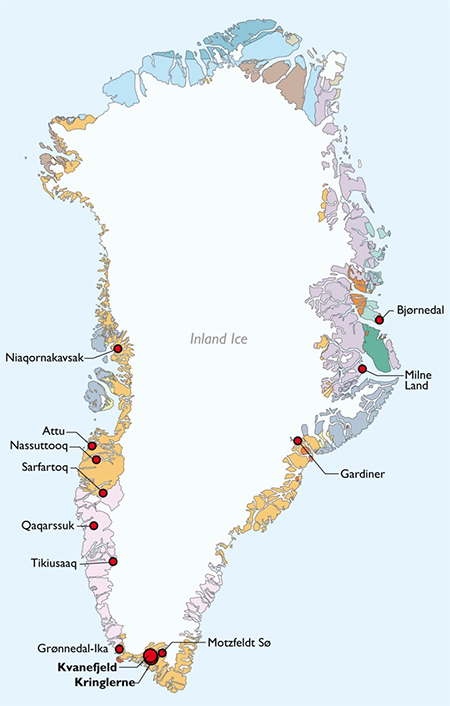
Beyond military considerations, Greenland holds untapped reserves of:
- Rare earth elements
- Uranium
- Zinc, iron ore, and possibly oil and gas
For the U.S., gaining influence over Greenland is part of a broader strategy to reduce dependency on foreign-controlled supply chains—particularly those dominated by China.
Understanding why the US wants Greenland requires analyzing military strategy, Arctic geography, and global power competition.

2. What Are Rare Earth Elements (REEs), and Why Are They So Important?
2.1 Definition and Composition of Rare Earth Elements
Rare Earth Elements are a group of 17 metallic elements, including:
- Neodymium
- Dysprosium
- Lanthanum
- Cerium
Despite their name, rare earths are not truly rare; rather, they are difficult to extract and refine in economically viable and environmentally safe ways.
2.2 Why Rare Earths Are Critical
Rare earth elements are essential to modern technology. They are used in:
- Smartphones and laptops
- Electric vehicle motors
- Wind turbines
- Advanced military systems (radars, missiles, stealth aircraft)
- Medical imaging devices
Without rare earths, modern digital and green technologies would be impossible.
2.3 Where Rare Earths Are Found Globally
Significant reserves exist in:
- China (dominant producer and refiner)
- Australia
- United States
- Greenland
- Parts of Africa (e.g., Madagascar)
However, China controls over 60–70% of global production and an even higher share of processing capacity, giving it immense leverage over global supply chains.
2.4 Why Nations Compete—and Fight—Over Rare Earths
Rare earths are not just economic assets; they are strategic weapons. Control over REEs allows a country to:
- Influence global technology markets
- Pressure rivals through export restrictions
- Secure military superiority
This is why Greenland’s rare earth potential alarms Washington and attracts Beijing’s attention.
Understanding why the US wants Greenland requires analyzing military strategy, Arctic geography, and global power competition.
3. Why Does the U.S. Want Greenland Despite Its Proximity to Canada?
Why the US Wants Greenland Despite Its Proximity to Canada
3.1 Greenland Is Not Canada—and Not Fully Independent
Although Greenland lies geographically close to Canada, it is an autonomous territory within the Kingdom of Denmark. This legal status makes it strategically distinct and diplomatically accessible in ways Canada is not.
The U.S. understands that influencing Greenland is:
- Easier than altering Canada’s sovereignty
- Less politically explosive than annexing a fully sovereign G7 country
3.2 Canada, the U.S., and Strategic Dominance
Canada is a close ally, but alliances do not erase competition. The U.S. seeks:
- Direct control or influence over strategic territories
- Reduced reliance on even friendly partners for critical defense assets
Greenland offers the U.S. strategic depth without the domestic political resistance that would come from overt pressure on Canada.
3.3 The “51st State” Narrative
Statements suggesting Canada could become the “51st state” should be understood less as literal policy and more as:
- Strategic rhetoric
- A reflection of U.S. confidence and dominance
- A signal that North America is viewed as a unified strategic space under U.S. leadership
Greenland fits into this worldview as an extension of continental security.
Understanding why the US wants Greenland requires analyzing military strategy, Arctic geography, and global power competition.
4. Why Is China Present in and Around Greenland?
4.1 China’s Arctic Strategy
Analysts agree that why the US wants Greenland is closely linked to rare earth minerals and Arctic shipping routes.
China officially describes itself as a “near-Arctic state.” While geographically distant, it sees the Arctic as vital to:
- Future trade routes (the “Polar Silk Road”)
- Access to rare earths and minerals
- Scientific and climate research
Greenland represents a gateway for China into Arctic geopolitics.
4.2 Economic Investments as Strategic Tools
China has pursued:
- Mining investments
- Infrastructure proposals (airports, ports)
- Scientific research partnerships
These activities are framed as economic cooperation but are widely viewed by Western governments as long-term strategic positioning.
4.3 Why the U.S. Is Alarmed by China’s Presence
For Washington, Chinese involvement in Greenland raises concerns about:
- Surveillance and intelligence gathering
- Control over critical minerals
- Dual-use infrastructure with military potential
As a result, the U.S. has actively pressured Greenland and Denmark to limit Chinese investments.
Understanding why the US wants Greenland requires analyzing military strategy, Arctic geography, and global power competition.
5. Conclusion: Why the World Has Become a Place Where Power Decides
The global system today is undergoing a profound transformation. The rules-based international order that emerged after World War II is increasingly challenged by:
- Great power rivalry
- Resource scarcity
- Technological competition
- Climate-driven geopolitical shifts
Greenland illustrates this reality perfectly. It is not its population or culture that attracts global powers—it is its location, resources, and strategic utility.
In this emerging world order:
- Military strength protects economic interests
- Economic power enables political influence
- Geography once again determines destiny
The competition over Greenland is not an isolated case; it is a symbol of a broader truth: in today’s international system, those with power set the terms, and those without power must adapt.
In conclusion, why the US wants Greenland reflects a broader shift toward power-driven geopolitics in the modern world.
As climate change reshapes the planet and technology reshapes warfare, territories once ignored are becoming decisive. Greenland is no longer a frozen frontier—it is a frontline of global geopolitics.
The question is no longer whether powerful nations will compete over such regions, but how far they are willing to go to secure them.
Understanding why the US wants Greenland requires analyzing military strategy, Arctic geography, and global power competition.
